Malcolm’s Berlin Diary Extracts
Towards the end of January 1945, Auxiliary Units was disbanded after four and a half years of strenuous preparation for the invasion that never happened. For the last 15 months of its life I had been DAOMG at the Headquarters near Swindon, and although later on the scene I felt very aware of the tremendous energy stored up in that extraordinary organisation which, if it had been called upon to fulfil its mission, might well have tipped the balance against an invading force. In its early stages as with so many of our defences there were no doubt gaping holes in the armour but as time went on and the threat of invasion still remained, and indeed at one time it seemed imminent, the training closed the gaps by the time I joined, late in 1943, the machinery of auxiliary units was as near perfect as could be devised. Almost from that time as the invasion bogey grew less, inevitably, came the stand down and finally disbandment. To have seen some of the staff that went to make up that intricate and highly skilled unit was a great privilege, for the very essence of England’s tremendous patriotism was there showing itself every now and again and startling and unexpected ways. But the end came, and without any undue fuss the parting of the ways was made, which meant, for those of us who constituted the regular army side of the organisation, a return to regimental duty.
For me, it was the Holding Battalion at Regent’s Park Barracks with public duties well to the fore, but the days of the Battalion were numbered and with the departure for North Africa of a magnificent draft of men mostly from the now disbanded Coats Mission and the general scarcity of trained men, those of us who were not going into the service battalions or Pirbright, were told to be on the lookout for any job we could get. I asked for an interview with the selection board and in due course was notified that I should present myself to one on 13th March.
The board, consisting of some half dozen officers with a colonel Richardson as president, was working in requisitioning premises in Hampstead. A very thorough and efficient system set to work to examine each lot of nine officers over a period of 24 hours, during which we were interviewed by all members of the board. This was my first and only contact with a psychiatrist. I formed the opinion that this job was the centre of the board’s activities and it made me wonder, rather apprehensively, how far I had slipped back from the active days at Pirbright in 1940. I think he was a bit surprised, when he asked me what I wanted to do, to hear that I wanted to do as useful and active a job as possible; I am sure that more than half of those being interviewed wanted anything but that, and in fact, some almost admitted it. Finally, the president summed up in each case and indicated what he thought was the most useful line of employment.
Failing my getting a job as OC troops on the ship which had been my pet objective for some time, Army Welfare services seem to offer the best chance of an interesting job with some chances of a “rise”. Accordingly, Colonel Richardson arranged for me to see Colonel Turnham (Deputy Director of Army Welfare Services) at 60 Eaton Square. After a talk he took me to see the director Major-General Green who seemed as though he would like to give me a job but made it fairly clear that the best chance of anything worth having was with the south east Asia command. This was rather a poser partly because it was very long way and partly because it might mean being abroad for an indefinite period whereas my ideas of OC troops on the ship would mean that I should least get back the extended tree of war permitting every few months. A few days later OMGI, Major Rhodes, to whom I had talked about the OC Troops job, telephoned to know if I would take an administrative job on a ship. This was quite a good chance of a useful and probably interesting job but looked like a dead end. I went to see Colonel Turnham to ask his views; he agreed that it was strictly limited for promotion and advised me to turn it down, which I did.
6 April 1945
One of the shortest and quite most exciting interviews I had had. Brigadier Morgan asked me a few perfunctory questions and then said how would you fancy being in charge of army welfare services in Berlin with the rank of Lieutenant Colonel? It rather took me back for a moment after being told by so many people, and so constantly in the previous few weeks that jobs were terribly hard to get at all and promotion practically impossible. However, after a moment I replied that it sounded very nice and I’d take it, thank you. In fact, of course I was more than delighted to have been offered such a marvellous chance of a really full-time and worthwhile job.
Sunday, 01 July
What a day to remember! We’re here, though it took a lot of doing and I haven’t had a chance to write anything until now. The advanced party has made the move to Berlin at last. We started the day with breakfast at 4 am and got away from the starting point on the autobahn at 5:40 according to plan. All went well as far as Magdeburg where we were to cross the Elbe by the “Friendship Bridge” into Russian occupied territory. For some reason or other the head of the column – there are about 100 vehicles in all – followed the autobahn and cross the river at the point below the town. This was over a temporary bridge close by the huge autobahn bridge which had been destroyed. At the far end of this temporary bridge was a Russian sentry who, after asking for identity papers from the leading car in which was Major General Lyne commanding the Berlin Garrison, let through about 10 vehicles, when a Lieutenant arrived and he and the sentry road and refused to let anything passed. As it happened, mine was the car stopped and it was a tense moment when the century levelled his Sten gun and looked very much like business, while we saw the leading cars of the column disappearing round the next corner. It was difficult, to say the least, and could easily have become dangerous but, fortunately, an officer in the car behind me spoke some Russian. Together we did our best to assure the little Mongolian Lieutenant that our papers really were in order for entry into Russian territory and had in fact been signed by Marshall Zukov, but nothing could make the slightest impression. His attitude was quite unshakeable and he said he didn’t care what Marshall Zukov had authorised, he wasn’t letting us through until his Captain said he could. No doubt they were both scared at having to let anyone through at all, which made them unreasonable, and the more we argued the more they dug their toes in. By this time several officers who spoke Russian fluently had arrived and it was arranged that contact should be made with the Divisional HQ of the Russians in Magdeburg. Two hours passed during which we became fast friends with the Lieutenant and several more of his party at the bridge, giving them cigarettes and taking photographs. At the end of that time a Russian Colonel arrived and met Brigadier Spurling whom he had managed to get back after the leading cars had gone through. Eventually the whole convoy turned and went back to the autobahn on the west of the Elbe, which is quite a performance in itself then made its way to the Friendship Bridge in the centre of Magdeburg. Here much time was spent in the most careful check on our numbers and while on the bridge, we could see bodies in the water in the backwaters of the piers. At last we were through and made the rest of the journey without incident. We were all very much impressed by the fact that the Germans were glad to see us. By 3.30pm, we had got as far as Charlottenburg in the suburbs of Berlin.
Saturday 14 July
I went to the Reichstag this evening. The destruction is terrible. At least half of this is wanton and systematic; everything is defaced and the whole place is a dreadful mass of fallen masonry, rubbish and filth of every kind and ever present smells. The Russians seem capable of making havoc of anything. Tomorrow I very much want to go to the Chancellery in case there may still be some souvenirs.
Sunday 15 July
During the afternoon I went off to the Chancellery. what a place it must have been! Hitler’s famous desk, a massive granite affair some 12 feet long and 9 inches thick, was overturned and smashed to bits. The destruction in the Chancellery and in the Reichstag was most thorough and must have taken a long time. I managed to find a number of medals and medal Ribbons which I want to identify, though I doubt any of particular value except as an interesting relic in the future. I also brought away a very useful wooden box not only as a momento but as a very badly wanted piece of luggage for the return journey.
Saturday 21 July
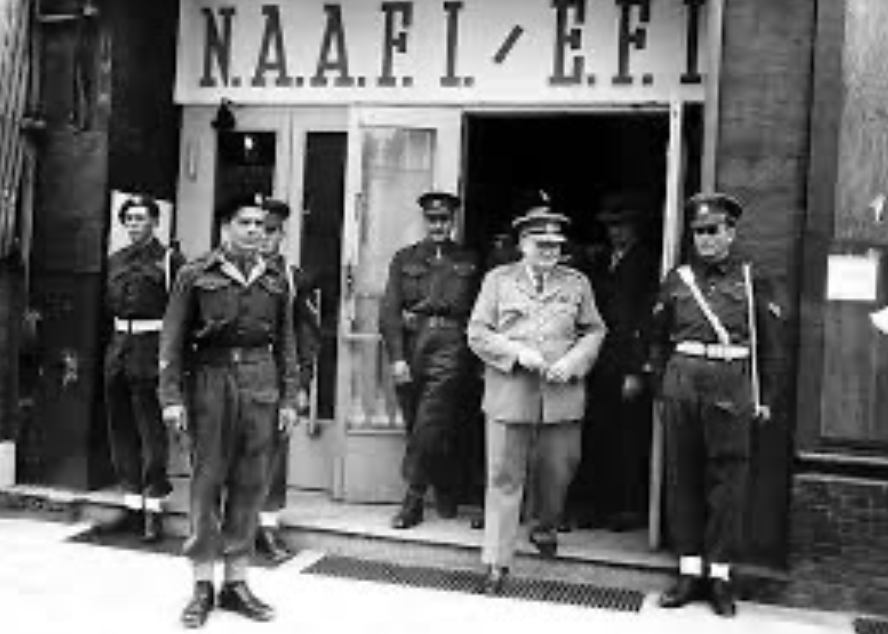
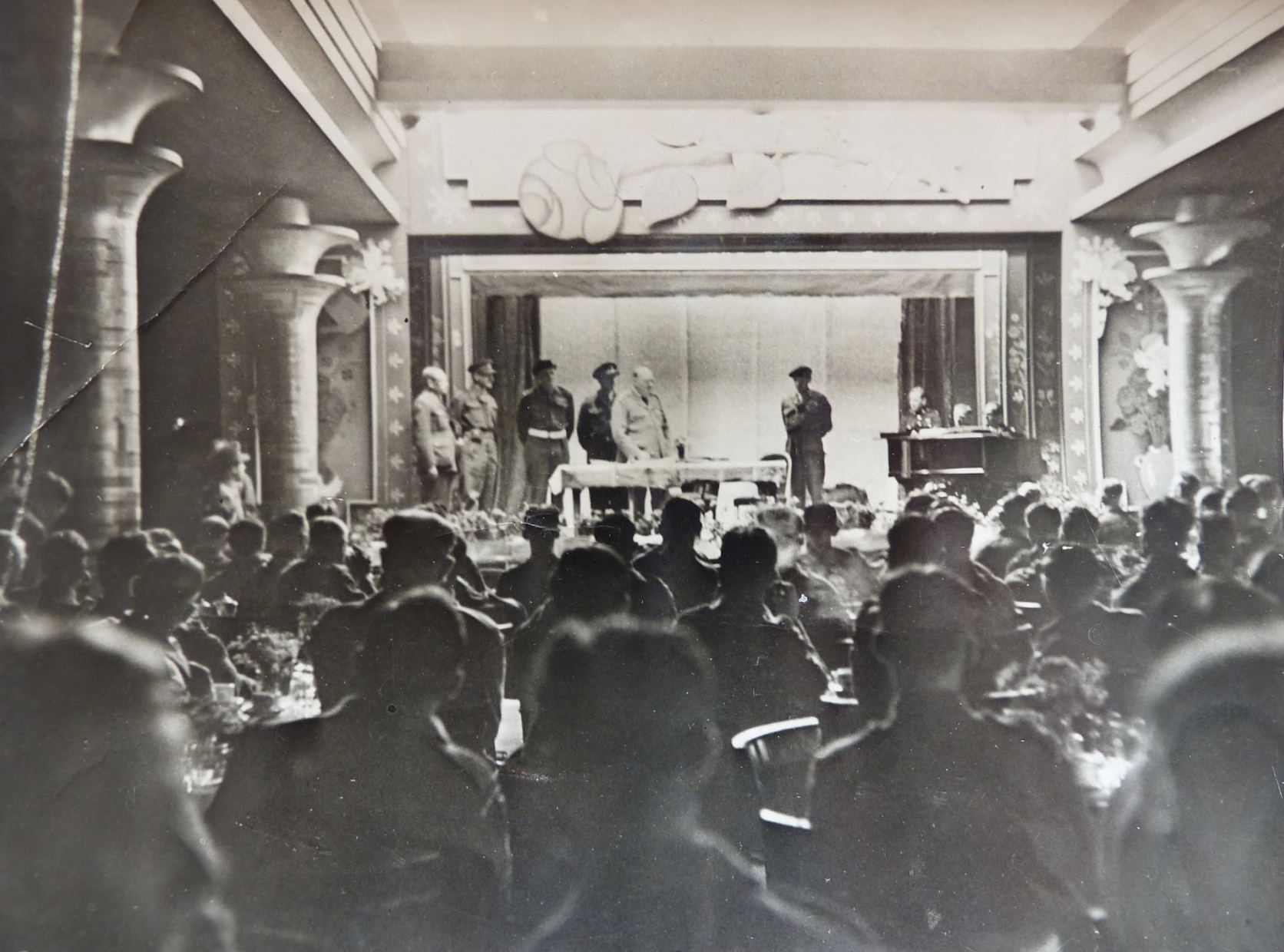
A memorable day. The Prime Minister came from the parade to open the Winston Club. I was told to conduct the party round. They arrived at 11:30, Mr. Churchill, Field Marshal Montgomery, General Lyne and Mary Churchill. When we got to the restaurant the band played “For he’s a jolly good fellow”. The PM then signed the declaration naming the building and also the visitors’ book. Then he made a first class impromptu speech to the troops there, and all went very well. Saw both commander Thompson, whom I had known at Chequers and Mary Churchill and was pleased to see that they both remembered me. As he left the building, I introduced to the PM the drivers of the mobile canteens which had been all through from the Normandy beaches. When he went towards his car, the big crowd, who had been kept at a distance on the far side of the street, broke through and stood around him and cheered. Yes, cheered! I would never have believed that any such thing could’ve happened if I hadn’t seen it. The inference is that in the first place his presence here signifies the real end of the war for them and, secondly, that they genuinely admire a great man and a leader.

Sunday, 29 July
A most enjoyable day. The highlight was the Philharmonic concert at the Theatre Des Weslens. It was packed and a tremendous success. I was delighted for Roly‘s sake as he had worked hard to get the show put on and to see everyone’s office enjoyment was most gratifying. Personally, I enjoyed the performance enormously and thought the music was very fine. 79 in the orchestra. They started the concert by playing God save the King which they didn’t know very well! Everyone wants us to run a concert every Sunday now so shall try and make suitable financial arrangements. Late again so must go to bed.
 The Somme
[…] Berlin – Welfare Officer […]