Eric Walter Hare and Repatriation 1942

I am indebted to Ian McLelland for supplying the information below about my Grandfather, Eric Walter Hare and his experience of being repatriated in WW2.

The first – and what became the only – Anglo-Japanese civilian exchange was held at Lourenço Marques in September 1942. On this occasion, around 1,800 Japanese were exchanged for a similar number of Allied government officials and civilians. Among those exchanged were 833 Japanese officials and civilians, including men, women and children, transferred from Australia. The overwhelming majority of the repatriates from Australia had been interned in Australia on behalf of other governments.

In 1942 the British and Japanese governments organised a prisoner exchange via the Portuguese East African port of Laurenco Marques.

One of the press clippings names E W Hare as one of those internees that was repatriated. (In this he was immensely fortunate as this was the only exchange of the war as far as the British/Japanese were concerned at least.)

The ship that brought him back was the NYK liner Tatatu Maru, which was spotted by an American submarine SS Kingfisher) that took a photo of the ship through the periscope, but didn’t attack because it was wearing colours identifying itself as a repatriation ship. I have attached this as well.

The majority of the British internees transferred to ships sailing for the UK, however some trying to return to India, Australia and NZ took months to get back as no formal arrangements had been made for them.

There is a book called ‘Lifeline Across the Sea’ by David J Williams which has a short chapter on this voyage.

clip_image008

clip_image010

clip_image012

Documents state that he arrived in Avonmouth from Sydney on the 28/9/1944, long before the Japanese surrender and that he was resident in Australia.

clip_image002

He then sailed out to New York on his way to Manila, Philippines on the 2/4/1945. The latter is certainly correct as Manila had just been liberated by US Forces.

This ties in with the electoral roll for Sydney in 1943 in which Eric Hare is listed .

clip_image004

Below is Petty’s Hotel, Sydney where he was living.

clip_image006

Yet more on Sidney Ernest Parkes

Contact with various parties in Australia continues to unearth more information about Sid.

First his WW1 Service Medal, The 1914-1915 Star, I believe, has appeared. Apparently, it was handed by a person who attended the 2014 ANZAC Day parade in Toodyay. This person was unknown and nobody got his name. At that time he claims he found them on a tip in the Perth Metro area, and he didn’t wish to see them go to land fill.

Sid Parkes' lost medal

Picture from Lost Medals Australia.

Also a Prior to his WWI service, he fought in the Boer War with the 1st NSW Mounted Rifles. He was wounded in action which reported in the papers at the time.

Sid Parkes wounded 1900 paper cutting


Sydney Ernest Parkes – his final resting place

I was pleased to bring another Parkes research to a conclusion. This time it was Sydney Ernest, who is buried in Shrapnel Valley, ANZAC. (More pictures below.)

Shrapnel Valley Cem & SE Parkes Grave 20-10-15 (5)

Shrapnel Valley Cem & SE Parkes Grave 20-10-15 (13)

He was a regular soldier and highly regarded:

Quote from TROOPER BLUEGUM AT THE DARDANELLES  by Oliver Hogue

Sid Parkes was small and slight, so small that he was almost rejected by the medical examiner. He had to show his South African record, and remind the doctor that giants were not wanted in the Light Horse, but light, active, wiry horse- men. So he just scraped through and went into camp. I remember him at Rosebery Park. Not much over five feet three, only about nine stone, but active and strong. He knew his mounted drill like a book, and he knew how to handle men; so he soon got his three stripes — and stuck to them. The men liked him. The officers appreciated him. We saw several other sergeants made and unmade, but Parkes of B Squadron was a fixture.
Already he had seen four years’ peace service, and eighteen months’ active service in South Africa with the New South Wales Mounted Rifles. So he brought the lessons of his previous experience to bear on his new job. On parade he did his duty well. Off duty he was a humourist, and as care-free as a schoolboy. On the transport he entered into all the fun going. In Egypt he played the game. Somehow, I always thought Parkes would come safely through the war. We joked together the night we first went into the trenches, never anticipating ill. Yet he was the first man of the regiment killed in the trenches. A sniper’s bullet came through a loophole and killed him on the spot.

Shrapnel Valley Cem & SE Parkes Grave 20-10-15 (2)

Shrapnel Valley Cem & SE Parkes Grave 20-10-15 (3)

Shrapnel Valley Cem & SE Parkes Grave 20-10-15 (8)

Shrapnel Valley Cem & SE Parkes Grave 20-10-15 (9)


Suvla Bay, Kidney Hill, Hill 60

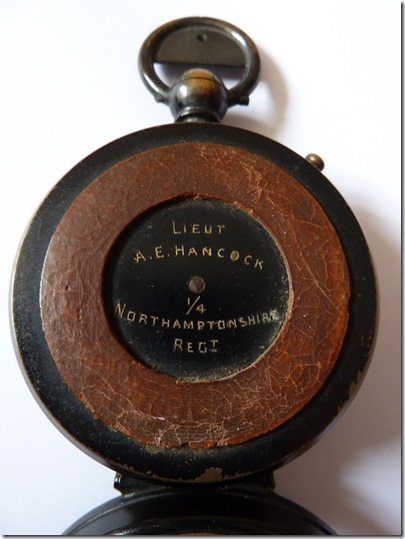
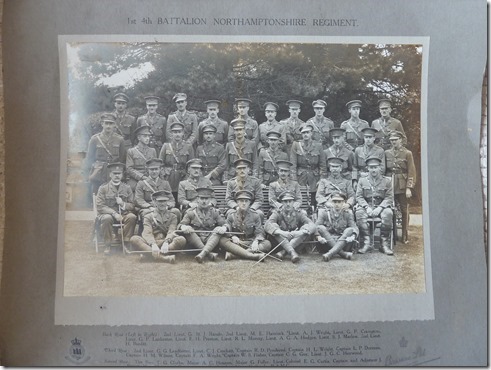
 I have recently returned from a trip to Gallipoli to re-trace Malcolm Hancock’s footsteps with 1/4the Northamptonshire. Below is a selection of photographs to show where he had been.

Suvla Bay “A” Beach – where he landed 15/10/1915. It was a wet and windy day when I visited.

Suvla Point A Beach & wreck of lighter 21-10-15 (1)_thumb[3]

Remains of a Lighter at “A” Beach

Suvla Point A Beach & wreck of lighter 21-10-15 (2)_thumb[1]

The area around Kidney Hill where Malcolm won his MC on 16th August 1915, less than 24 hours after landing. It was even wetter and windier than at “A” Beach!

Suvla Kidney Hill & area 21-10-15 (1)_thumb[2]

Suvla Kidney Hill & area 21-10-15 (2)_thumb[1]

Suvla Kidney Hill & area 21-10-15 (3)_thumb[1]

Suvla Kidney Hill & area 21-10-15 (4)_thumb[1]

Suvla Kidney Hill & area 21-10-15 (5)_thumb[1]

Hill 60 where he was holding the trenches and bombing officer for the Brigade.

Hill 60 21-10-15 (6)_thumb[2]

Hill 60 2015-10-21 (1)_thumb[2]

Views from Hill 60.

Hill 60 2015-10-21 (4)_thumb[2]

Hill 60 2015-10-21 (5)_thumb[1]